
I. Case background and recent development
On November 20, 2025, in In Re: Issue Relating to Definition of Aravalli Hills and Ranges, the Supreme Court accepted the new definition of Aravalli Hills proposed by the Ministry of Environment, Forest and Climate Change (“MoEFCC”). This recent judgment of the Supreme Court is not an isolated event, but rather the latest chapter in a long-standing legal battle over the protection and management of the Aravalli range.
The Aravalli range spreads across north-western India and extends through Gujarat, Rajasthan, Haryana, and Delhi. The total area covered by Aravalli is approximately 1.15 lakh square kilometers. For decades, Aravalli range has not only been the oldest mountain range in the world, but it has been extremely vital in maintaining ecological balance. It acts as a natural barrier that prevents the Thar desert from expanding further into India. It is also helpful for the oxygen production it does to stop desertification. The Aravalli Range also supports forests, groundwater recharge, and biodiversity, and plays a crucial role in improving air quality and oxygen levels in nearby regions.
The different states the Aravalli ranges pass through use different definitions of Aravalli ranges, and there is no uniform definition of “Aravalli range”. Due to this ambiguity, regulating mining and construction activities became difficult. To address this, during 2024-25, the Supreme Court directed the MoEFCC to propose a uniform and scientific definition to clearly identify which part of the land is within the Aravalli system.
In this case, the vacation bench comprised Chief Justice of India B.R. Gavai, Justice K. Vinod Chandran, and Justice N.V. Anjaria, approved the new definition as “Aravalli ranges are defined as landforms situated in the Aravalli districts “having an elevation of 100 metres or more from the local relief.” The Aravalli Range, meanwhile, is described as “two or more Aravali Hills, located within the proximity of 500 m from each other, measured from the outermost point on the boundary of the lowest contour line on either side”. The Court further directed scientific mapping and a sustainable mining plan. Until such measures are implemented, the Court restrained authorities from granting any new mining leases.
II. Issues before the Court
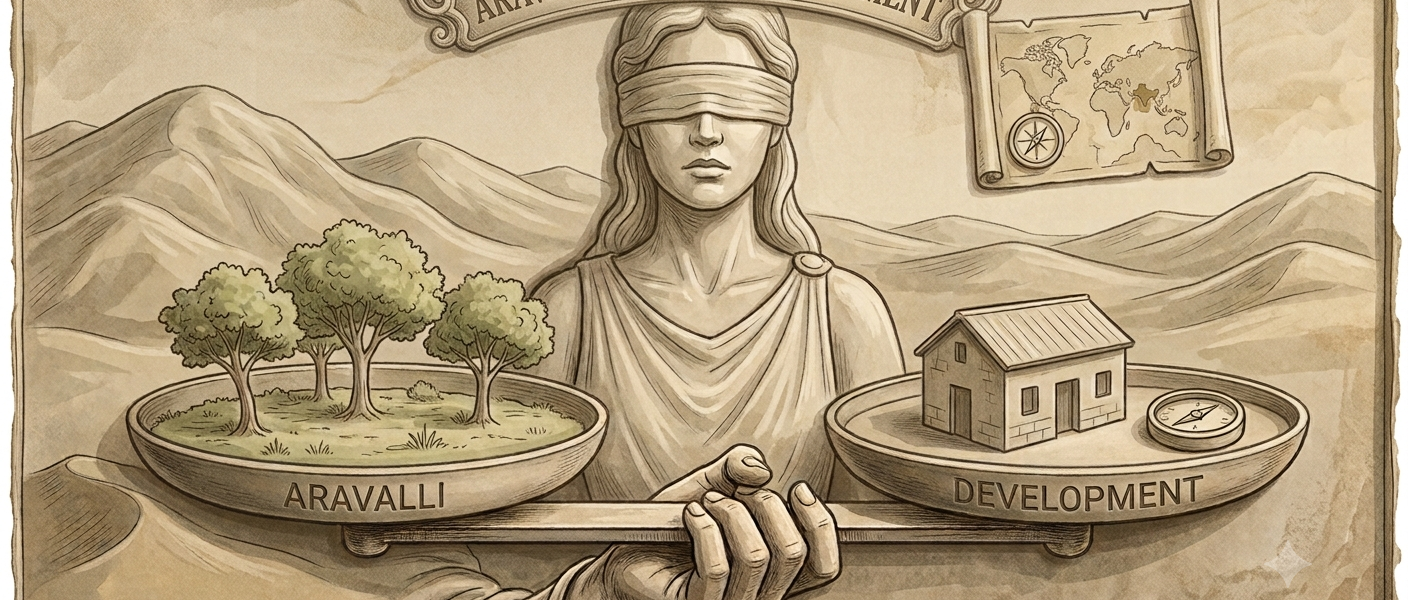
In this case, the core dispute was how to balance controlled resource exploitation with environmental preservation within one of India’s oldest and most fragile mountain ecosystems. This case can be analyzed through four principal sub-issues.
- Whether the lack of a uniform definition of the Aravalli Hills and Ranges across the four concerned States (Gujarat, Rajasthan, Delhi, Haryana) had been enabling illegal and unregulated mining and whether the Court could settle such a definition?
- What is the legal definition of “Aravalli Hills” and “Aravalli Range” that should be used to govern mining operations?
- Whether a framework for sustainable mining was the best course of action or whether a total prohibition on mining in the Aravalli range was justified?
- How to identify and safeguard the range’s core and inviolate natural areas against mining operations?
III. Observations of the Supreme Court:
Consolidation of Proceedings and Definitional Vacuum
The Court was seized of issues relating to Aravalli Hills and Ranges in two concurrent proceedings: M.C. Mehta v. Union of India & Ors. and T.N. Godavarman Thirumalpad v. Union of India & Ors. These proceedings were consolidated before a common Bench to avoid conflicting orders.
The Court acknowledged that the longstanding absence of a uniform definition of the Aravalli ranges had repeatedly stalled enforcement of mining restrictions and conservation protocols. Different States relied upon varying and often revenue-oriented classifications such as “gair mumkin pahar” or “banjar land” which were never designed to track geomorphological continuity or ecological function, thereby enabling regulatory dilution over decades.
Acceptance of the Uniform Scientific Definition
Upon receiving the report of the Committee constituted by the Court through the MoEFCC, which included representatives from the Forest Survey of India, the Central Empowered Committee, and the Geological Survey of India, the Court accepted the uniform elevation-based definition. “Aravalli Hills” were defined as any landform in the identified Aravalli districts having an elevation of 100 metres or more from the local relief, including supporting slopes and enclosed landforms. An “Aravalli Range” was defined as two or more such hills located within 500 metres of each other, measured from the outermost point on the boundary of the lowest contour line on either side.
The Court commended the Committee’s work and appreciated its recommendations for the prevention of illegal mining and the allowance of only sustainable mining in Aravalli Hills and Ranges. The Court noted that this definition replaced the prior fragmented state-level classifications that had historically undermined conservation efforts.
Constitutional and Environmental Law Principles
The Court invoked foundational environmental law doctrines, for ex; the Precautionary Principle and the doctrine of Inter-Generational Equity, alongside the constitutional guarantee of the right to life with dignity under Article 21. It reiterated the principle, first articulated in T.N. Godavarman Thirumalpad v. Union of India, that ecological protection cannot hinge on administrative revenue labels also must be guided by the ecological characteristics of the terrain in question.
For context, the Court observed that the Aravalli Range is among the oldest geological features on the planet and one of the oldest fold mountains in India. The scientific assessments placed before the Court established that the Aravalli ecosystem acts as a “green barrier” and an effective “shield” against the desertification, preventing the eastward spread of the Thar Desert towards the Indo-Gangetic plains, Haryana, and western Uttar Pradesh.
The Court also rejected State-level attempts to regularise encroachments and dilute conservation zones, firmly reaffirming that the protection of the Aravalli range is a matter of national ecological security that transcends state-level economic or administrative interests.
International Obligations
The Court further invoked India’s obligations under the United Nations Convention to Combat Desertification (“UNCCD”), ratified on December 17, 1996. It held that Articles 4 and 5 of the UNCCD require India to adopt an integrated approach to address desertification, strengthen existing laws and undertake long-term policy measures. The Court noted that the MoEFCC had launched the “Aravalli Green Wall Project” to restore degraded land and prevent desertification, and that these international obligations necessitated a uniform and scientifically guided approach toward preservation and regulation of exploitation in the Aravalli ecosystem.
Management Plan for Sustainable Mining (MPSM) and Moratorium on New Leases
Drawing upon the precedent established in the Saranda Wildlife Sanctuary matter, where a similar Management Plan for Sustainable Mining had been formulated through a geo-referenced ecological assessment by the Indian Council of Forestry Research and Education (“ICFRE”), the Court directed that an equivalent MPSM be developed for the entire Aravalli range.
The Court held that no new mining lease shall be granted until the MPSM is finalized. However, the order did not impose a blanket ban on existing, legally operating mines. Mining in core and inviolate areas which includes Protected Areas, Tiger Reserves, Eco-Sensitive Zones, wetlands, and CAMPA plantation sites, was absolutely prohibited. The Court emphasized that uncontrolled mining in the Aravalli Range poses a “great threat to the ecology of the nation” and that, according to Article 21 of the Indian Constitution, short-term financial advantages cannot take precedence over long-term environmental rights.IV.
Directions Issued by the Court
The Court issued the following key directions:
a) Acceptance of the uniform elevation-based definition proposed by the MoEFCC for “Aravalli Hills” and “Aravalli Range” across all four States.
b) A moratorium on the grant of any new mining leases until the MPSM is prepared and implemented
c) Direction to the ICFRE to conduct a landscape-wide geo-referenced ecological assessment for the preparation of the MPSM.
d) Absolute prohibition on mining in core and inviolate zones, including Protected Areas, Tiger Reserves, Eco-Sensitive Zones around Protected Areas, wetlands, and CAMPA plantation sites.
e) Mandate for strict regulation of existing operations, including adherence to environmental and forest clearances, continuous monitoring, and enforcement against illegal mining through surveillance technology such as drones, CCTV, and weighbridges.
f) Direction to the States to undertake scientific mapping of Aravalli Hills and Ranges on official Survey of India toposheets to make boundaries objective and enforceable.