Centre for Law and Policy Research, Bangalore (CLPR) is a not-for-profit dedicated to making the Constitution work for everyone through law and policy research, social and governance interventions...


Search results for:
Centre for Law and Policy Research, Bangalore (CLPR) is a not-for-profit dedicated to making the Constitution work for everyone through law and policy research, social and governance interventions...
The Chair for Public and Comparative Law at Humboldt University Berlin (Prof. Dr. Philipp Dann) in collaboration with the journal VRÜ / WCL offers two short-term research scholarships for emerging...
The Opportunity The Indian Equality Law Visiting Fellowship is aimed at capacity-building for early career scholars. Applications are invited for two or three visiting fellows to spend one month at...
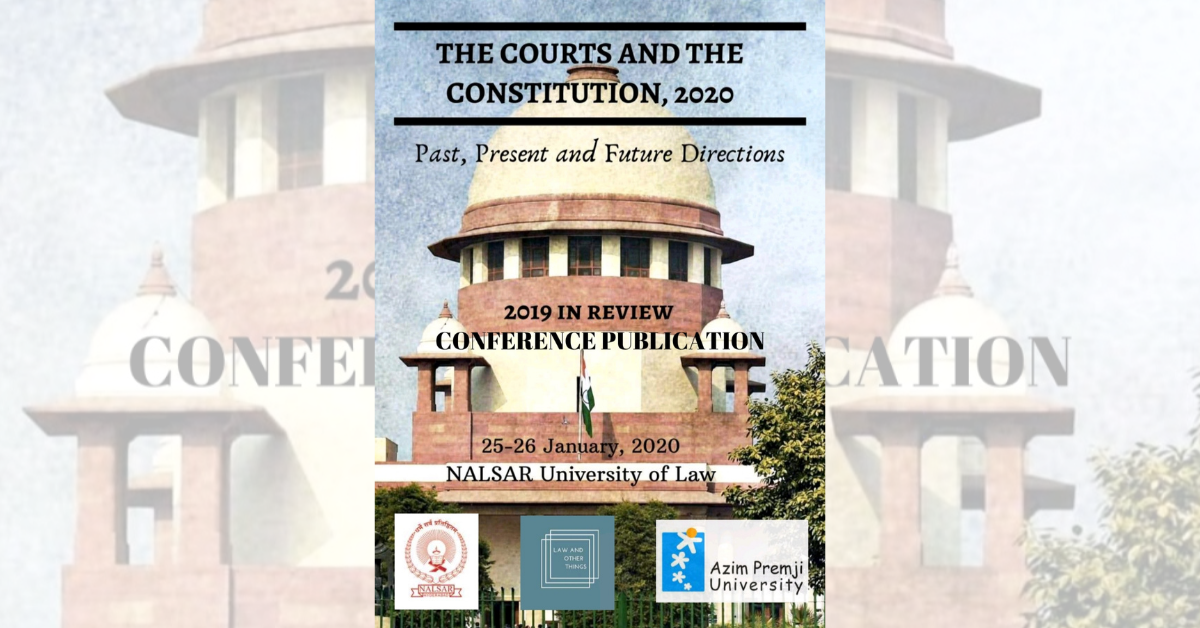
NALSAR University of Law recently concluded the second edition of its ‘The Courts and the Constitution Conference’ held in partnership with Azim Premji University and the blog Law and Other Things...

In January 2019, Law and Other Things, in collaboration with the National Academy of Legal Studies and Research and Azim Premji University, organized the first Court and Constitution Conference in...
A woman in Assam is determined not to be a citizen of India by the NRC. She seeks review by a Foreigners Tribunal. She faces a formidable task. She bears the burden of proving that she is a citizen...

The Citizenship Amendment Act alters the definition of ‘illegal immigrant’ for the purposes of the Citizenship Act 1955. It provides that ‘persons belonging to minority communities, namely, Hindus...

On 13 November, 2019 the Constitution bench of the Supreme Court of India in the case of Central Public Information Officer, Supreme Court of India v. Subhash Chandra Agarwal has held that the office...

The Supreme Court Observer invites you to attend ‘The Supreme Court in Review, 2019’, in partnership with the NCS chapter of the St. Joseph’s College of Law, Bangalore. The event will bring together...

Taxation is omnipresent and makes its presence felt in all spheres of life. From a legal standpoint, when one contemplates on the fundamentals of taxation, the first set of questions which arise are...