

On 12 May 2026, the Supreme Court of India directed the State of Rajasthan to introduce Rajasthani as a subject in all government and private schools and to progressively facilitate its adoption as a medium of instruction, starting at the foundational stage. The immediate occasion was a PIL seeking inclusion of Rajasthani in the examination syllabus for teacher recruitment. But the judgment in Padam Mehta and Another v. State of Rajasthan (2026 INSC 476) (Hereinafter, ‘Padam Mehta’) does something constitutionally more significant than resolve a local curriculum dispute. It settles, and then extends, a question about the nature of the right to mother-tongue education that Indian courts have been circling for over three decades.
The settled part is familiar. Article 19(1)(a) of the Constitution, which guarantees freedom of speech and expression, includes the right to receive information in a meaningful and comprehensible form, and therefore encompasses the freedom to be educated in a language of one’s choice. This was established in State of Karnataka v. Associated Management of English Medium Primary and Secondary Schools (2014) 9 SCC 485 (Hereinafter, ‘Associated Management’), where a Constitution Bench held that a child or her parent has the right to choose the medium of primary instruction under Article 19(1)(a), and the State cannot override that choice on the ground that it knows better. What is new in Padam Mehta is the step that follows. The Court has now located within Article 19(1)(a) not just a negative liberty against state imposition but an affirmative obligation on the State to create the conditions under which that right can actually be exercised. That move deserves scrutiny.
The Old Framework and its Limits
The 2014 judgment in Associated Management arose in an unusual context: the State of Karnataka had mandated Kannada as the medium of instruction at the primary level, effectively removing parental choice. The Constitution Bench struck this down. In doing so, it confirmed that Article 19(1)(a) has a receptive dimension: the right to receive information is as much a component of free expression as the right to transmit it. This reading had earlier support in the Court’s 1995 ruling in Ministry of Information and Broadcasting v. Cricket Association of Bengal, which held that the freedom of expression protects the flow of information in both directions.
But the 2014 ruling did not go further. It protected the right to choose from interference but said nothing about what the State must do when the chosen language has no infrastructure to support it. A child in rural Rajasthan who is constitutionally entitled to learn in Rajasthani cannot exercise that right if no school teaches it, no teacher knows it at the required level, and no examination recognises it. The right, in those conditions, is formally protected and practically inaccessible. This is the gap Padam Mehta confronts.
What the Court Actually Held
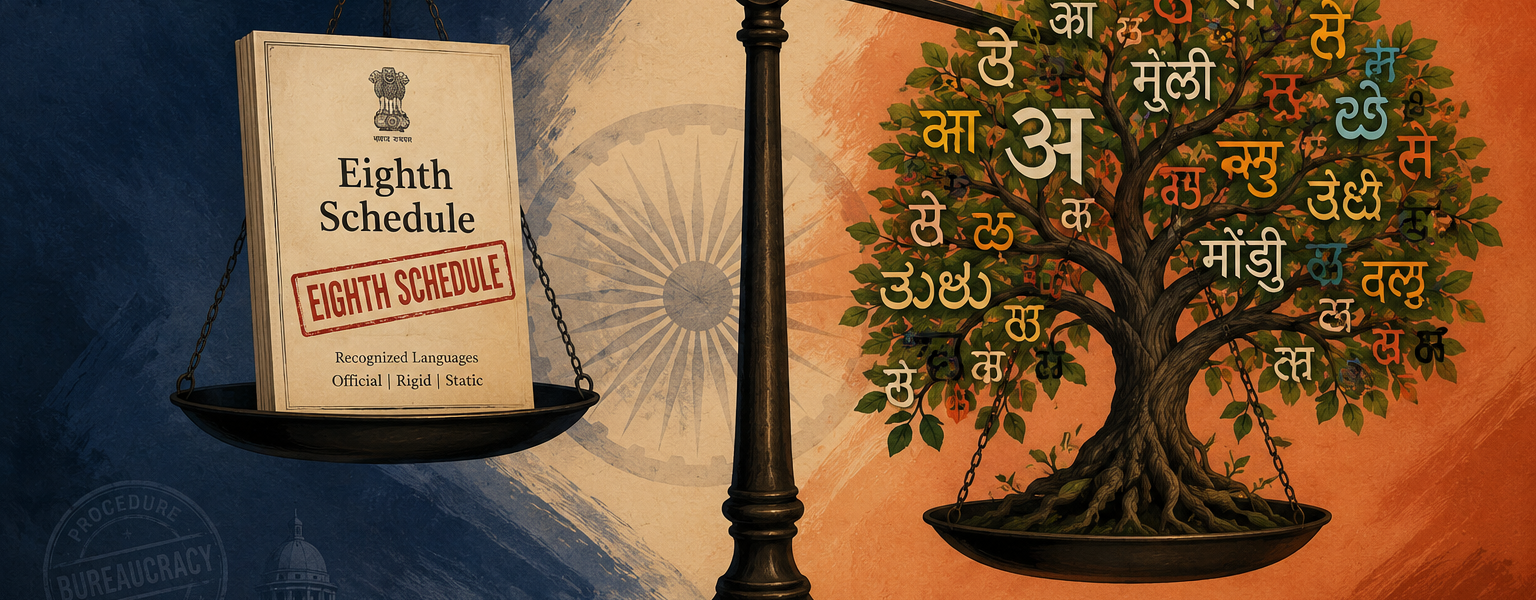
The State of Rajasthan’s defence before the Court was, in essence, bureaucratic: Rajasthani is not listed in the Eighth Schedule to the Constitution, so there is no policy framework to include it in school curricula or teacher recruitment. This argument has a surface plausibility. The Eighth Schedule lists twenty-two officially recognised languages, and state education systems have long structured their curricula around its categories.
The Court rejected this position in terms that are worth reading carefully. It called the State’s stance ‘myopic’ and ‘pedantic’, and pointed out that Rajasthan’s own universities already offer undergraduate and postgraduate degrees in Rajasthani at institutions including Jai Narain Vyas University, Jodhpur, and the University of Rajasthan, Jaipur. A State that offers M.A. degrees in a language while simultaneously refusing to include it in a school syllabus on the ground that the language lacks recognition is not applying a coherent principle; it is deferring action behind a procedural technicality.
More importantly, the Court held that the Eighth Schedule and Article 19(1)(a) operate in different constitutional registers. The Eighth Schedule determines which languages receive official status at the Union and State level; it has never purported to define which languages a child is entitled to understand. Article 350A, inserted into the Constitution by the Seventh Amendment in 1956, separately obligates States to provide adequate facilities for instruction in the mother tongue at the primary stage for children of linguistic minorities. The Court’s point is structural: Part III rights do not derive their content from the Eighth Schedule. A language may carry no official status while still being the mother tongue of millions of children who are constitutionally entitled to understand what they are being taught.
This separation is the analytical core of the judgment. By refusing to allow the Eighth Schedule to act as a ceiling on the rights available under Part III, the Court avoids a category error that has long distorted Indian language education policy: the assumption that constitutional entitlements are bounded by official recognition lists that were themselves assembled for entirely different purposes.
The Obligation the Court Creates
Having established that the right exists independently of Eighth Schedule status, the Court issues concrete directions: formulate a comprehensive policy for mother-tongue-based education, recognise Rajasthani as a regional language for educational purposes, and introduce it as a subject in all government and private schools in a phased manner. A compliance affidavit is due by September 2026. Importantly, the Court does not derive this obligation from Article 19(1)(a) alone. Rather, it grounds the obligation in a cumulative reading of Articles 19(1)(a), 21, 21A, 41, 45, 51A(k), and 350A, alongside Section 29(2)(f) of the Right to Education Act and the National Education Policy, 2020. The result is a shift in the structure of the right itself.
Associated Management established a right against interference with language choice. Padam Mehta establishes an obligation to take affirmative steps towards making that choice realisable. The Court grounds this in a cluster of constitutional provisions read together: Articles 21, 21A, 41, 45, 51A(k), and 350A. The combined effect, the judgment holds, is that quality education cannot be a formality. Instruction that a child cannot comprehend because of language barriers is not, in any meaningful sense, instruction at all, as the Court notes in paragraph 35 of the judgment.
The Court also draws on Section 29(2)(f) of the Right of Children to Free and Compulsory Education Act, 2009, which mandates that the medium of instruction shall, as far as practicable, be in the child’s mother tongue, and on the National Education Policy, 2020, which recommends mother-tongue-based instruction up to at least Class V. The significance of this lies in how the Court treats these instruments. Rather than reading NEP 2020 as an aspirational executive policy that states may defer indefinitely, the Court treats it as evidence of what the constitutional mandate actually requires. A State cannot cite the absence of a statutory framework as a reason for inaction when the constitutional framework, the statutory scheme, and its own government’s policy all point in the same direction.
A Litigation Pathway Beyond Rajasthan
The implications of this reasoning extend well beyond Rajasthan. India has over a hundred languages spoken by substantial populations that have no Eighth Schedule recognition (Vaidya et al., 2025). Bhojpuri has an estimated fifty million speakers. Tulu has around two million. Gondi, spoken across multiple central Indian states, has approximately two and a half million speakers (Chandra, 2020). For decades, the Eighth Schedule argument has effectively closed the constitutional door on these communities: no official listing, therefore no enforceable entitlement.
Padam Mehta substantially weakens that argument. The Court’s reasoning does not depend on any characteristic unique to Rajasthani. It depends on a structural constitutional logic: the right under Article 19(1)(a) to receive education in a comprehensible form is not contingent on that language’s official recognition under a different constitutional provision designed for a different purpose. If that logic is sound, it ought to apply wherever a child’s mother tongue is demonstrably different from the medium of instruction and the State has done nothing to address that gap.
The Court’s emphasis on Rajasthan’s existing university-level recognition of the language suggests that some evidence of institutional legitimacy is relevant. This is a practical constraint that prevents the argument from being extended to every informal dialect or regional variation. But it is a threshold of evidence about the language’s standing, not a threshold of official status in the Eighth Schedule. Languages with established literary traditions, institutional study, and identifiable speaker communities are not categorically excluded from this framework.
The Limits Worth Acknowledging
Two limitations deserve candid acknowledgement. First, the Court’s directions run to Rajasthan specifically. The constitutional reasoning is general, but the operative relief is state-specific and tied to evidence about Rajasthan’s treatment of the language. Extending this reasoning to other languages in other states will require fresh litigation grounded in comparable facts about the exclusion, the population affected, and the State’s existing posture towards the language in question.
A possible objection is that the Court constitutionalises what was previously treated as pedagogical policy, without fully defining the limits of the State’s obligation. Questions of feasibility, linguistic diversity, and institutional capacity remain unresolved.
Second, the Court directs the State to formulate a policy and file a compliance affidavit; it does not prescribe the content of that policy in detail. This leaves considerable administrative discretion with the State, and the history of court directions in education matters in India is not uniformly encouraging. Whether the September 2026 compliance affidavit produces genuine institutional change or formulaic paperwork remains to be seen.
These limits, however, do not diminish the significance of what the Court has done analytically. The constitutional framework it articulates is now available to future litigants. The question of what a State must do rather than merely what it cannot do when a child’s language is excluded from the educational system has been given a principled answer.
Conclusion
Padam Mehta is not a revolutionary judgment. It does not introduce a new constitutional right, resolve the political controversy over Eighth Schedule expansion, or prescribe a uniform national language policy. What it does is take the existing doctrinal framework seriously and follow it to its logical conclusion. If Article 19(1)(a) includes the right to receive information in a form that the recipient can actually understand, and if education is the primary vehicle through which a child receives and processes that information, then a State that systematically excludes a child’s home language from the educational system is not just failing a policy goal; it is undermining a constitutional guarantee.
The shift from negative liberty to affirmative obligation is not dramatic in formal doctrinal terms. But in a country where many millions of children attend schools that do not teach in their home language, it is a shift with very practical stakes. Whether courts will enforce this logic consistently, and whether states will respond with genuine effort or procedural compliance, are different questions. The constitutional argument, at least, is now cleaner than it was before 12 May 2026.
Author Bio: Kshitij Saruparia is a graduate of NALSAR University of Law, Hyderabad and Apeksha Kachhawaha is a graduate of Maharashtra National Law University, Nagpur
Ed note: This piece was edited by Hamza Khan and published by Vedang Chouhan from the Student Editorial Board


