
INTRODUCTION
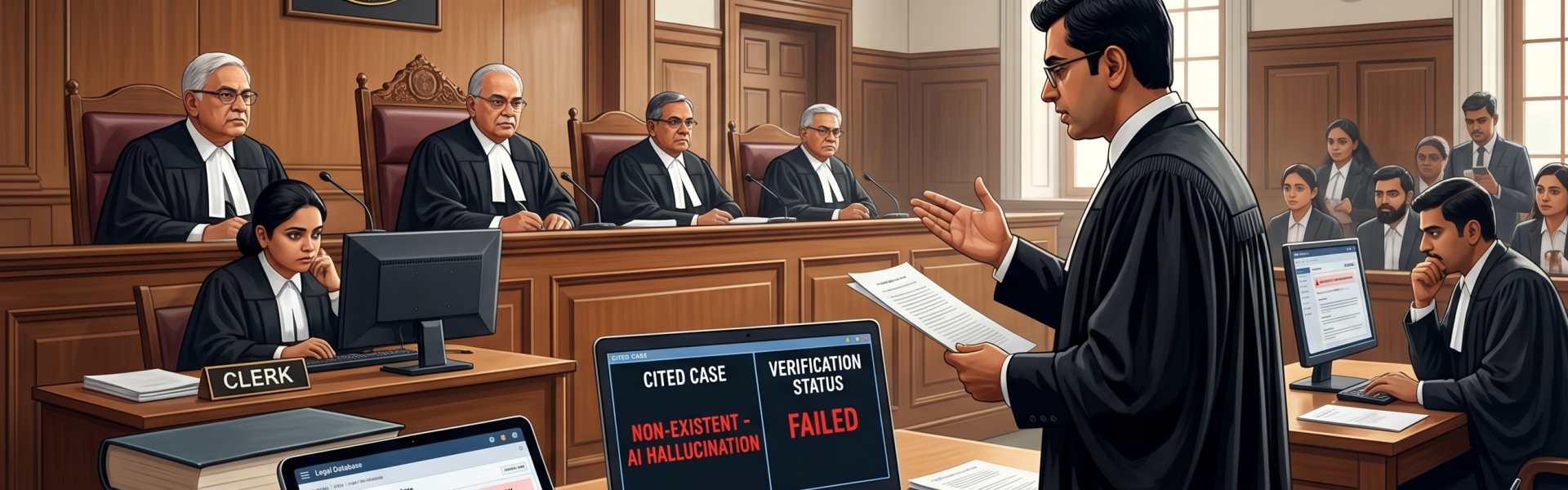
The Supreme Court of India made an announcement on 26 March 2026 which would have seemed farfetched ten years ago. Hearing a special leave petition in the case of Heart and Soul Entertainment Ltd., the court stated that the circulation of so-called non-existent AI-generated judgments had become a problem of epidemic proportions. Not only in India but in the entire world. It was not the first occasion when the Supreme Court had to say something on this issue. The same bench of Justice PS Narasimha and Justice Alok Aradhe had taken suo motu cognizance of a trial court order made in Andhra Pradesh on 27 February that was based on four fabricated judgments. They said that a decision based on such non-existent and fake alleged judgments is not an error in decision-making process. It is misconduct, and legal consequence would follow.
In September 2025, the Delhi High Court had to deal with something even more insidious than a nonexistent citation, a case with an authentic citation who’s cited paragraphs or ratio doesn’t exist in the official judgment.
These are not individual deviations. They are the statistics of a trend that is gaining momentum around the world. French researcher Damien Charlotin who is the founder of the only known dedicated global database of AI hallucination cases in courtrooms worldwide has documented more than 1,247 reported cases in the world as of early 2026. Even more mind-blowing than the volume is the velocity: prior to spring 2025, the number of such cases was about two cases per week throughout the world; by late 2025, it had increased to two or three cases per day.
- LEGAL FRAMEWORK IN INDIA: WHAT IS ALREADY IN THE LAW?
In November 2025, the Supreme Court issued a White Paper, called Artificial Intelligence and the Judiciary, through its Centre for Research and Planning. The paper mandates any summary, precedents list and ratio generated by using AI tools must be independently verified by judges and staffs. The major gap in this paper is its focus only on judge’s use of AI rather than lawyers use of AI. The White Paper proposed a number of indigenous AI tools: SUPACE, which is an ML application that helps judges to extract summarized facts and precedents based on the case records; LegRAA, an AI-based research assistant that uses Supreme Court judgments to generate issue summaries and a list of precedents; and an AI-based e-Filing Scrutiny Tool. The white paper is more like a suggestive document without any pragmatic enforcement as it guides judges and staff to verify their AI usage but does not give them standard mechanism to do so for lawyer’s submission. It leaves this entirely at subjective discretion of staffs. Such mechanism has demonstrably failed to stop fabricated cases in submissions.
On the High Court level, the Kerala High Court was the first court in India to grant a formal, documented and binding policy of AI to the lower courts. The Kerala policy, applies to not only judicial officers but to all employees, interns and law clerks in the service of the district judiciary. In clause 4.6 AI is banned to be used for arriving at any findings or judgment. As per that any AI generated results by judges must be verify through official database. Failure in doing so attracts action under Kerala civil services act 1960. The same limitation arises here, guidelines focuses on judges and court staff usage of AI rather than emphasizing on lawyers AI submissions which is a major source of fabrications. It emphasizes on internal AI usage and not AI submissions enter from outside of courts through lawyers.
A recent landmark judgment in the case of Heart and Soul Entertainment Ltd.by apex court is the only judgment which talks about lawyer’s usage of AI for hallucination and fabricated citations. It held that if lawyers use AI to cite fabricated cases in submission such act will come under professional misconduct and not count just as a general error. While a significant decision, but this works on after effect solution rather than any prevention mechanism. Most cases in India are resolved and pending in lower courts, and they are not capable to identify such fabrication due to humongous workload and absence of standard policy to prevent misuse. Reliance on just a precedent is not a solution to protect legal system from perils of AI fabricated submissions, India needs uniform binding guidelines especially for lower courts.
III. THE GAP: SCATTERED, REACTIVE, AND SILENT WHERE IT COUNTS THE MOST.
When a lawyer files a written submission with an imaginary citation to a district court on a typical working day in 2026, the court registry receives the filing. It is stamped by a clerk and put into the case file. The case is set down to a subsequent date. Whether the mentioned cases exist or not is not confirmed by anyone. Nobody has verified that the paragraphs quoted of those cases are authentic. The court has no specific tool towards this purpose, no protocol to do it, and no positive legal obligation compels the clerk or the judge to do it.
49 million cases in all levels of Indian judiciary are still pending, over 43 million, or over 85 per cent, of the cases are pending in the courts of districts alone. The Supreme Court alone has over 87,000 pending cases. However, the Indian litigation in the actual sense, more than 85 percent of all pending cases, happens in the district and subordinate courts. To the vast majority of litigants, district courts represent the end of the road as an appeal to the High Court involves resources, time, and access to the law that most common litigants lack. The district court order is absolute for most of the classes. And the judges of the district courts cannot do the verification, current framework is silently presupposing. An empirical study of a sample of more than 1,700 Indian district courts, carried out on behalf of the Cambridge journal Data and Policy, revealed that the median workload per judge in Indian district courts amounts to 4,270 cases per year. Thefigure when divided by number of working days gives a judge 14 to 17 minutes per case per hearing day.
The same study observed that in Indian district courts, irrespective of the level of productivity, there is a very low number of judges in the courts. It is not just wishful thinking to expect that a district judge should have to manually cross-reference all citations in all written submissions against SCC Online or Manupatra. Additionally, verify whether that particular paragraph has been quoted in the text of that particular case. It is operationally implausible.
- SOLVING THE AI PROBLEM OF AI WITH AI: A CASE OF MAKING PRE-FILING VERIFICATION A MANDATORY PRACTICE.
The technology that allows creating phantom precedents is also the one that can recognize them on a large scale. The policy reform proposed in this paper is two-fold.
First: A Binding BCI National Framework on Citation Verification. The Bar Council of India should come up with a mandatory, enforceable national circular, which is applicable in all courts and in all levels, stating that all cases written submissions with references to case law should have a certificate of verification. The BCI circular must state that the citation should be drawn out of one of the list of suggestive approved repositories – SCC Online, Manupatra, Indian Kanoon and the submission must have the database generated citation reference to the fact that the case does exist. Violations filing a citation that cannot be produced by an approved repository would make the submission unacceptable in court.
Second: A Compulsory Citation Integrity Module in the eCourts E-Filing System.
The reform in terms of infrastructure is convincing. The eCourts e-filing portal has already enabled over 5,187 court establishments, and 92.08 lakh cases have already been e-filed through the portal as of September 2025. The Supreme Court, collaborating with IIT Madras has already developed and tested AI systems to identify defects in the e-filing system.
The proposed Citation Integrity Module would serve as a compulsory step that is integrated into the current e-filing process. The module would also automatically cross-reference all the cited cases with legal repositories at the point of submission. It would yield two results, first, a verification that the case in question is in the database and, most importantly, a full-text match check that the given paragraph or ratio or similar decision was found in the judgment.
A filing that does not pass this check would not be rejected directly but would create an obligatory discrepancy flag, which would be visible to the judge in which the case is listed before hearing. This is in response to both types of hallucination: citation hallucination is identified by the existence check; paragraph hallucination is the most dangerous type of hallucination, identified by the text-match check. This idea is technically possible without the use of a large language model. LegRAA already intersects confirmed legal databases, and keeps audit records of all recommendations, which is the same architecture applied to incoming advocate submissions instead of judicial research queries, would be the verification role the paper describes.