
Introduction
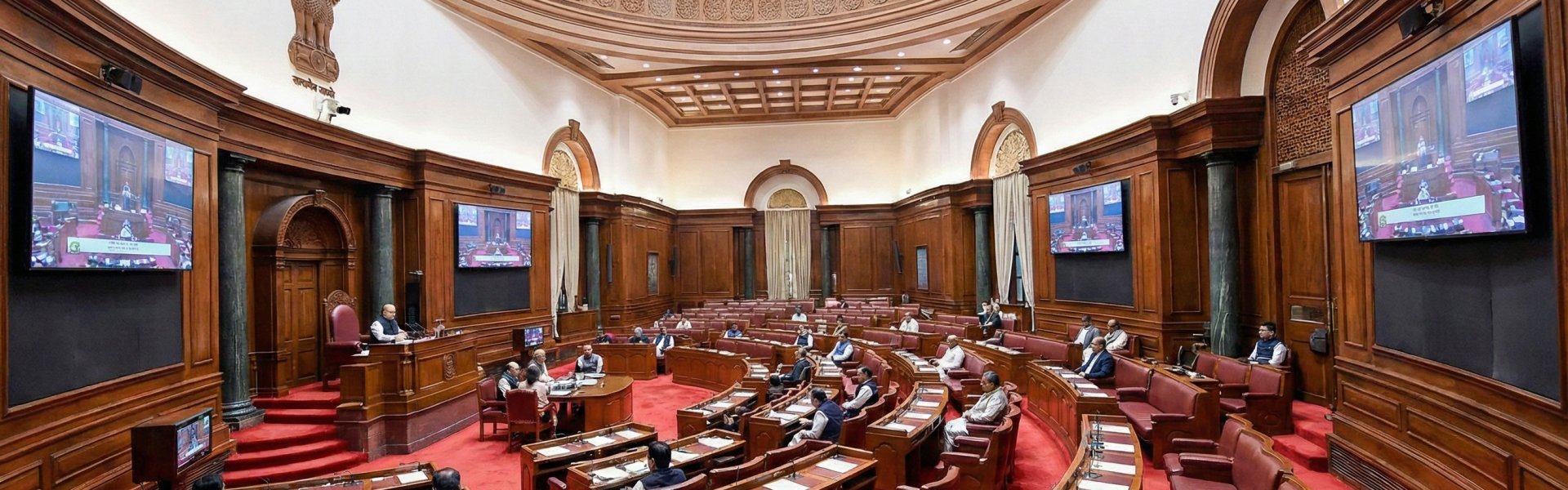
The Rajya Sabha was conceived as a Chamber that would cool the passions of the directly elected Lok Sabha, offer measured revision of legislation and represent the interests of the states in the national law-making process. However, as the Rajya Sabha Secretariat’s own reports (2009,2022) and later analyses by the Observer Research Foundation show, the Rajya Sabha’s federal and deliberative roles seem increasingly undermined. Committee referrals have declined sharply over two decades and several major bills including the 2020 farm laws and 2023 criminal law amendments were passed with minimal debate. These patterns suggest that legislative oversight has been systematically weakened. The rise of party whips, rapid legislative procedures and the declining frequency of detailed committee engagement have turned the upper house into a largely political space rather than a forum for thoughtful scrutiny. Although the Constitution gives the Rajya Sabha the potential to delay, revise and refine, its present functioning often mirrors the electoral majoritarianism of the lower house.
With Parliament increasingly legislating in domains involving complex economic, technological and regulatory issues, the mismatch between the Chamber’s constitutional design and its practical capacity has become more pronounced. This article argues that strengthening the Rajya Sabha’s deliberative identity requires the institutional inclusion of non-voting, state nominated experts, who enrich committee work without undermining the federal or political balance of the chamber. The argument evaluates the Rajya Sabha against its constitutional design, the classic function associated with upper chambers in comparative political theory and the practical demands of contemporary legislation while also acknowledging the tension between technocratic expertise and democratic accountability.
Why Expertise Matters for a House of Review
There are three functions of an upper chamber widely recognised in the bicameralism literature: (i) Deliberation insulated from partisan politics; (ii) Detailed revision supported by information and expertise; and (iii) Federal representation. These functions underpinned the House of Lords’s functional role before the 1911 reforms, Ireland’s vocational panels and continues to guide discussions on reforming upper houses across parliamentary democracies.
While the Rajya Sabha has performed the third function, its institutional design at present is ill-suited for both unpartisan deliberation, and inclusion of expertise. At present, technical areas like Securities, Anti-trust, financial regulation are delegated to regulatory bodies with extensive delegation of legislative powers. This framework, however, has two flaws: First, the Parliament should lay down the essential legislative policy to avoid excessive delegation claims, and the regulatory experts are involved only once the parent statute has been enacted; Second, these experts in the regulatory bodies are appointed by the Govt. and the opposition members are left with no role to play in the formulation of these crucial regulatory policies.
One possible response is that Parliament already has access to expertise through consultations, regulators think tanks and advisory bodies. But these mechanisms have three limitations. First, they are episodic and inconsistent as it is on the committees to choose whether or not to seek expert input. Second, procedural constraints mean that external experts appear late in the legislative process, often after political positions are fixed. Third, the pace of contemporary legislation which is frequently passed with limited debate leaves little space for external review to shape substance. Such measures help at the margins, but they do not create a stable institutional presence capable of providing continuous, domain specific scrutiny across the entire legislative cycle.
Balancing Democratic Representation with Expertise
If the Rajya Sabha is to regain its deliberative function without disrupting the federal balance, reform must respect two constraints: First, experts should not disturb electoral representation; Second, they should not be subordinated to party whips.
The way forward could be inclusion of subject-matter experts in the Rajya Sabha with full rights of participation in policymaking except for voting, to be nominated by state legislatures. The core of this proposal is simple: experts are non-voting members. They do not count towards party numbers, do not vote on bills and are subject to whips. This ensures that the Chamber’s federal composition, determined by state elected MPs remains untouched. Though this framework does not change seat distribution and is hence electorally neutral, it is significant because consistent expert scrutiny has the potential to shape the content and direction of legislation.
Full participation in committees is where actual law making happens and would give experts real influence at the most critical stage of the legislative process. While retaining their non-voting status on the floor, experts would enjoy full rights within committees to write clause-by-clause comments. They would scrutinize fiscal, constitutional, and regulatory implications and provide sector-specific insight that could shape the contours of a law. This arrangement allows for real influence at a point where technical expertise is of greatest value in the detailed crafting and refinement of laws while maintaining political control at the final voting stage, where accountability appropriately resides. These experts would participate through statutory recognition or as an amendment to the Rules of Procedure without themselves becoming constitutional members under Article 80 and hence without requiring a constitutional amendment. It is this balance that recognizes the Central tension in democratic design. While legislative authority must remain with elected representatives, effective democratic accountability also requires that decision-making be informed, reasoned, and publicly defensible.
State level nomination and accountability
In order to enhance federalism, the nomination of experts should be by State Legislative assemblies and not by the Union. States may designate nominees through either a committee of the Legislative assembly or an appointments panel constituted by statute, ensuring transparency while limiting partisan capture. Each expert would present an annual performance report to a designated State Legislative Committee and could be removed for non-performance or misconduct through a supermajority vote. This ensures accountability without tying the experts to central party leadership.
One possible counterargument is that Article 80 already allows the president to nominate twelve members with expertise in various fields. However, this category serves a fundamentally different constitutional purpose. The framers intended it to bring cultural and intellectual breadth to parliament, not to supply sustained regulatory, economic or technological expertise. Moreover, nominated members are fully voting members and often vote along partisan lines undermining their independence. Their selection by the Union executive does not advance the federal character of the Rajya Sabha nor do twelve individuals suffice to support the extensive committee system. The proposed Model of state-nominated, non-voting experts therefore supplements rather than duplicates, the Constitution’s existing provision.
While no comparative system mirrors this model exactly, several illustrate the broader principle that structured expertise can be institutionalised without displacing democratic representation. The United Kingdom’s Crossbench peers contribute expertise without voting. Ireland’s Seanad integrates vocational expertise through panels. The Australian Senate’s Committee system demonstrates that technical depth can significantly influence legislative quality even without altering political votes. Similar pathways have strengthened policy analysis in Canada’s Senate and New Zealand’s select Committees.
Conclusion
The Rajya Sabha was never intended to be a replica of the Lok Sabha. In fact, it was created to correct it, to keep a check on majoritarian impulses, maintain federal balance and subject law to critical scrutiny. This has been an expectation the House has struggled to fulfil, because its institutional design has failed to keep up with the demands of modern legislating. Adding state-nominated, non-voting experts with full committee rights offers a constitutionally coherent, politically neutral and institutionally realistic way to revive its deliberative identity.
This reform treats expertise as a structural input rather than as a political threat and strengthens India’s parliamentary democracy at a time when the complexity of lawmaking demands this kind of institutional imagination.
Arihant Jain is a second-year law student at National Law University, Delhi. His interests lie in constitutional law, public policy, and politics.
[Ed Note: This piece was edited by Hamza Khan and published by Vedang Chouhan from the Student Editorial Team.]