
Introduction
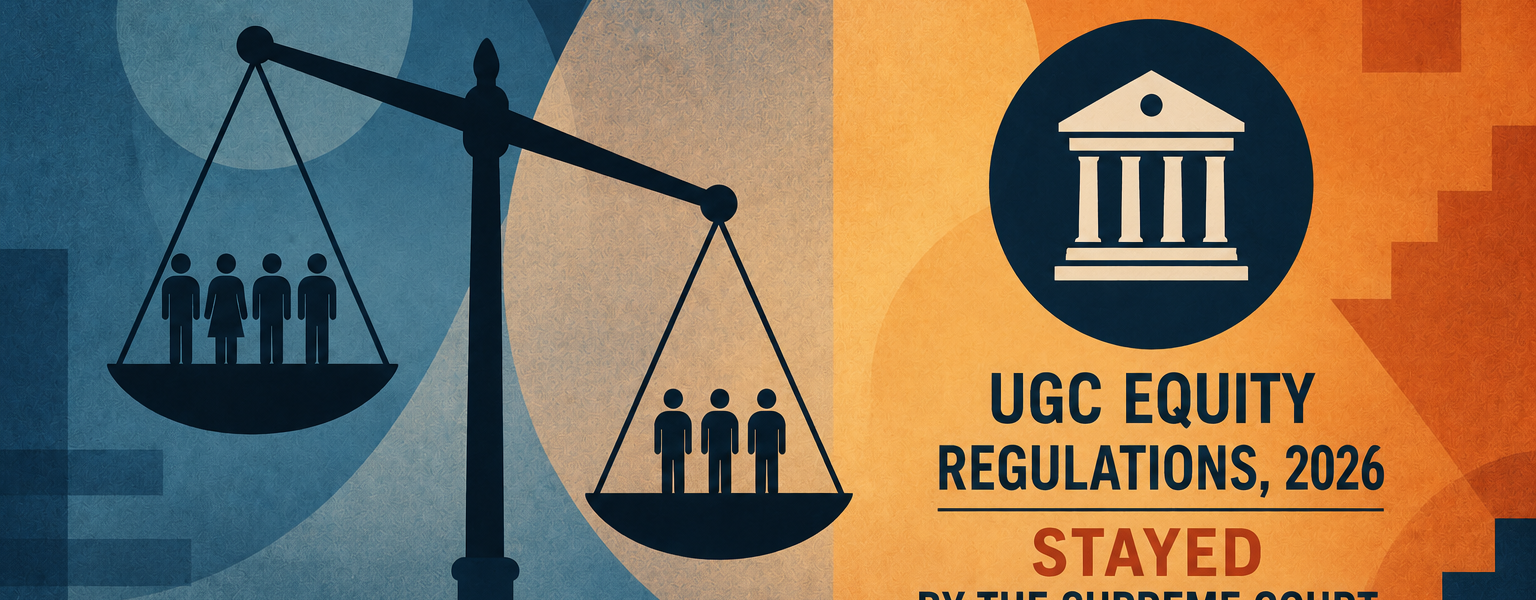
On 29 January 2026, the Supreme Court stayed the UGC (Promotion of Equity in Higher Education Institutions) Regulations, 2026 (“Regulations”) in Mritunjay Tiwari v. Union of India. The Regulations had transformed the earlier advisory 2012 framework into an explicit, structurally grounded regulatory scheme. The stay directed the 2012 Regulations to continue operating pending final adjudication. The order is brief, but read carefully, it does something significant: it identifies, in the Court’s own words, a prima facie constitutional problem with how the Regulations define caste discrimination. This essay argues that the instinct behind the stay points toward a formalist understanding of equality that the Constitution’s own structure does not support.
This essay reads the stay order closely to show that the Court’s questions embed a symmetry assumption that recent equality jurisprudence has already moved away from. It then argues that the Constitution’s own directional logic, confirmed by Nitisha’s structural sensitivity doctrine, already accommodates the method clause 3(c) applies.
What the Court Actually Said?
The provision under challenge is clause 3(c) of the Regulations, which defines ‘caste-based discrimination’ as discrimination against members of Scheduled Castes, Scheduled Tribes, and Other Backward Classes. The Court records the Petitioner’s objection that: this definition ‘renders completely remediless’ individuals from non-reserved or general categories ‘even if they are subjected to caste-based discrimination or institutional bias,’ and that the Regulations ‘proceed on an unfounded presumption that caste-based discrimination is necessarily unidirectional and can never operate against persons belonging to non-reserved or general categories.’
The Court subsequently takes a prima facie consideration that some of the provisions of the Impugned Regulations suffer from certain ambiguities, and the possibility of their misuse cannot be ruled out and frames 5 questions for detailed examination. This piece analyses court’s approach in the first question, which is the point of contention that:
Whether the incorporation of Clause 3(c) in the Impugned Regulations, defining “Caste-based Discrimination”, bears a reasonable and rational nexus to subserve the object and purpose of the 2026 UGC Regulations, particularly in light of the fact that no distinct or special procedural mechanism has been prescribed to address caste-based discrimination, as opposed to the exhaustive and inclusive definition of “Discrimination” provided under Clause 3(e) of the Impugned Regulations?
There are two things worthy of notice. First, it is in the very words of the Court, rational nexus, separate but equal, which appeals invariably to the vocabulary of formal equality, but not of structural equality. Secondly, its question is framed in terms of asymmetry as a constitutional issue, rather than a method. The Court considers asymmetry as an error whereas the Regulations consider asymmetry of the clause as a design choice. To put it simply, the question proceeds as though symmetry were the baseline, requiring the State to justify deviation, rather than considering whether symmetry is the right baseline for this kind of harm at all. That tension is the core of this discussion.
The Formalist Lens and Its Limits
The classification test adopted by the court: “whether Clause 3(c) bears a reasonable and rational nexus to the object of promoting equity”, takes a formalist approach, and puts the question whether a group specific definition to caste discrimination can pass the test of intelligible differentia and rational connection challenged by Article 14. In his article, Tarunabh Khaitan states that formal equality is concerned with whether a rule draws distinctions “on its face” between similarly situated individuals, and whether that classification bears a rational nexus to its objective. It does not consider the social implications that may arise after the rule is enacted but the naked text of the rule. In this reading, identifying caste discrimination by group-specific concepts seems absurd when the object of regulation is equity, since the notion of equity, which is formally taken, is meant to be universally accessible.
But the recent Indian doctrine of equality has never rested wholly on formal equality alone. Starting in 1974, E.P. Royappa v. State of Tamil Nadu acknowledged the infringements of equality without a clear comparator. In Lt Col Nitisha v. Union of India, the Court clearly dismissed a mere face-based examination of neutrality. It emphasized that formally gender-neutral standards, including the criteria applied in the evaluation of permanent commission, could give rise to “indirect discrimination”, by institutionalizing structural disadvantage in supposedly neutral policy. The emphasis was placed on social impact of the rule rather than hard text of the rule. This was a departure from strict symmetry that is reflected in the criticisms of Khaitan, who refers to the classification test as a narrow interpretation and believes that the equality review should not be limited to the internal logic of a rule, but should consider the forms of disadvantage within which it functions. The current stay order, however, seems to take us back to a pre-indirect discrimination system, in which asymmetry in definition itself is viewed as suspect.
While Nitisha moved away from formal symmetry, it stopped short of answering whether it is possible to state, in the language of the definition, in a certain way, who the principal agents of a structural harm are? Nitisha tackles the downstream impact of neutral rules on disadvantaged groups but does not tackle whether the State can incorporate that awareness into the very language of definition of a regulation. This is the gap that Clause 3(c) reveals and the Court has tried to resolve this by invoking the classification test.
The Petitioner’s objection about bidirectionality aggravates the matter. He argues that there is a two-way directionality in caste-based discrimination, that it is possible to have discrimination in either direction, and that the law must be open to all possible complainants. According to this argument, Clause 3(c) excludes some people at the definition point and it predetermines who qualifies as a victim, not leaving it to case-by-case investigation. However, it must be noted that the Constitution itself is not necessarily always addressed in absolutely symmetrical language. Articles 15(4), 16(4), and 17 permit the State to identify particular communities as structurally disadvantaged and to frame remedies around that recognition. Whether Article 14 in any event necessitates such a two-way neutrality is the real question, although directional design is permitted elsewhere in the Constitution.
When the Constitution Speaks Directionally
The above gap between recognizing structural disadvantage as a constitutional principle and using it to define a harm (in this case, clause 3(c)) can be bridged by considering the Constitution itself, as opposed to confining the analysis to the classification test. The question is not whether the Constitution ever tolerates the use of asymmetric language. It clearly does. The answer to this is whether this permission is confined to the particular areas of Articles 15, 16, and 17, or whether one can apply the same reasoning to the formulation of a regulation.
Those provisions already establish an important principle. Articles 15(4) and 16(4) do not treat all groups identically; they authorise the State to identify particular communities as historically disadvantaged and to design measures accordingly. In Indra Sawhney v. Union of India, the Court affirmed that provisions such as Articles 15(4) and 16(4) are constitutionally authorised responses to entrenched social and educational backwardness, reflecting the Constitution’s commitment to substantive equality.
Article 17, too, is not framed in neutral terms. It abolishes untouchability as a historically specific practice directed at particular communities. In each case, the Constitution speaks not as an exception to equality, but as a way of giving effect to it, because the harms being addressed are themselves structured and unequal. Clause 3(c) follows the same logic. It applies that method to the context of higher education, where caste-based exclusion continues to operate in historically grounded ways.
Vandita Khanna‘s reading of Nitisha helps clarify this move. Khanna elaborates that the Court acknowledged that a formal rule of neutrality may nonetheless be discriminatory to the extent that it does not consider the social context within which its application takes place. This critique of Nitisha helps clarifying that the structural sensitivity of this case is a doctrinal commitment, rather than a remedial reaction to a particular pattern of facts, and that the commitment is equally in effect when structural disadvantage is encoded in the definition of a harm at the regulatory designing stage.
This is further evident when one thinks of how the Court is seemingly worried about the issue of asymmetry itself. Asymmetry is not necessarily an issue. It may be a constitutional procedure in that it mirrors the framework of the harm under consideration. Caste discrimination is not a two-sided identity conflict, but it is a historically rooted exclusion system. That reality is acknowledged in the Constitution. A regulation that names the primary bearers of that harm is therefore not abandoning equality but applying, at the regulatory level, the same directional logic that the Constitution itself adopts in its text.
Conclusion
The stay of Mritunjay Tiwari raises a unique constitutional concern. The framing used by the Court: rational nexus, and asymmetry as defect, indicates the persistent alignment towards formal equality even where recent constitutional jurisprudence has moved away from it. That pull is not unreasonable. The classification test is real, the misuse concern is real, and the procedural foreclosure problem the petitioner raises deserves a serious answer from the bench.
But the very system of the Constitution offers the answer. It has always been directional where history was directional – in Articles 15(4), 16(4), 17, and in the sensitivity of structure Nitisha has made a doctrinal commitment. This method was not invented under clause 3(c). It implemented it on the regulatory level. The issue before the three-judge bench is not thus whether directional definitional language can be used in the abstract. That has been already answered in the Constitution. The inquiry is, must Article 14 insist upon expressive symmetry even in cases where the social conditions are not–and the court in answering this question must have the guidance of the directional logic of the Constitution itself, not despise it.
Author Bio: Aaradhya Nigam is a second-year BA LLB student at National Law School of India University, Bengaluru with developing interests in constitutional governance, criminal law, and emerging questions at the intersection of technology and regulation. He hopes to build a career that combines public law research with work on tech-driven legal challenges and institutional accountability.
Ed note: This piece was edited by Hamza Khan and published by Vedang Chouhan from the Student Editorial Board