
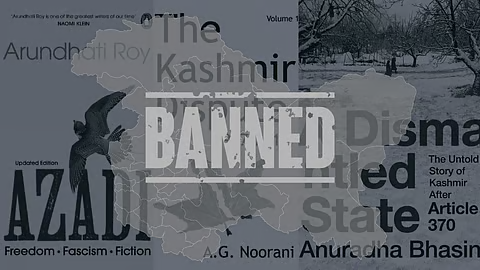

Abstract: This article examines the Jammu & Kashmir administration’s 2025 ban on 25 books through a constitutional and socio-legal lens. It introduces the concept of the “fear of the spectator” to argue that censorship operates not only by restricting content but by presuming the audience’s incapacity to engage with it rationally. Situating the ban within India’s free speech jurisprudence, the article contends that the state fails to meet the established incitement threshold under Article 19(2), as articulated in Shreya Singhal and related cases. It argues that the ban reflects a paternalistic and colonial logic that suppresses democratic deliberation. Ultimately, the piece calls for judicial intervention to protect readers’ interpretive autonomy and uphold a robust, inclusive vision of free expression.
On 5 August 2025, exactly six years after the abrogation of Article 370, the Jammu & Kashmir Home Department released a notification proscribing 25 books, from Arundhati Roy’s ‘Azaadi’ to A.G. Noorani’s ‘The Kashmir Dispute’. The ban emanates from the government’s logic that these texts disseminate false narratives that misguide youth and glorify terrorism. The Home Ministry in the notification mentions that these books attract the provisions of Sections 152, 196 & 197 of Bhartiya Nyaya Sanhita 2023 as they have been found to excite secessionism and endangering sovereignty and integrity of India. Through this article, the author investigates what the ban says overtly and covertly and whether it fulfils the standard of incitement which is required to limit the freedom of expression. The author then employs socio-legal analysis to understand how the law pertaining to ban functions to erase the ideological underpinning of the state’s administrative actions and further limit the scope of democratic deliberation through top-down assessment of interpretative capacity of the masses.
- The Fear of the Spectator
Banning literature works on two dimensions. Firstly, it dictates what can be read and what cannot be and secondly, it determines who can read and who cannot. While the first prong is widely read under the light of freedom of expression and authorial independence, it is necessary to engage with the second prong with keeping the right of representation of information or receiver’s/audience’s right to hear/read diverse viewpoints into consideration before forming an opinion.
The second prong rests on the colonial understanding of ‘restless native’ that are assessed to be incompetent to intellectually interact with literature, without affecting the public order. The ban then emanates from the ‘potential offence caused’ or the ‘response of’ certain readers, rather than the inherent nature of the work (like being libelous or slanderous) and permits the state to decide the interpretative limits of the citizens engaging with the texts. The state defines the contour of existence of a legal fiction of ‘reader-writer citizen’ taking on the role of protecting the ‘unwashed masses’ (from where such reader-writer citizen emerges) from baser instincts that could ignite their (unruly) passions.
Parallelly, this also draws an idea of inborn criminality, which means that for certain groups criminality is hereditary, i.e., a biological trait that could be transmitted by birth rather than learned through social circumstances. For if the state recognizes that the perceived unruly responses of the citizen are stemming from the social circumstances, mitigating such circumstances shall become its obligations, which is difficult to fulfill when state, itself, is an active party in the conflict. For this blog, I shall refer this assessment as the ‘fear of the spectator’ that is created by the state to limit the discursive space available.
- Reading the Kashmir Book Ban through the fear of spectator framework
The Kashmir Book Ban largely targets texts which include works of history and reportage. Written by scholars such as A.G. Noorani, Sumantra Bose, Christopher Snedden, and Victoria Schofield, these texts are historical and analytical works whose focus is on documenting political developments, contextualising disaffection, or exploring alternative political futures that cannot reasonably be construed as incitement to terrorist offence. Even if these texts articulate unpopular or uncomfortable perspectives on Kashmir’s autonomy, they remain within the protected realm of democratic deliberation. On the logic of Justice Brandeis in Whitney v. California that the response of bad speech is more speech, even if the state finds the texts ‘bad’ the same must be countered through responses rather than proscription.
From a constitutional perspective, the state’s justification for banning these works fails to meet the required threshold of incitement. The Supreme Court of India has consistently held that restrictions on speech under Article 19(2) must meet a stringent incitement threshold. In the case of Shreya Singhal v. Union of India, the Court clarified that freedom of speech and expression comprises three stages namely discussion, advocacy, and incitement and that Article 19(2) becomes applicable only when expression reaches the stage of incitement. This distinction was reaffirmed in Arup Bhuyan v. State of Assam, where the Court held that mere advocacy of a cause, however unpopular, cannot be curtailed unless it can be equated with incitement to imminent violence. This test is further refined through apex court’s ruling in Superintendent, Central Prison v. Dr. Ram Manohar Lohia, holding that there must be a proximate and reasonable nexus between the speech and a threat to public order. Similarly, in S. Rangarajan v. Jagjivan Ram, it was observed that the anticipated danger must not be remote or speculative but should have a direct and immediate connection with the expression “like a spark in a powder keg.”
The high threshold of incitement thus ensures that only speech which is likely to result in imminent violence or disorder can be restricted, making it difficult for the state to invoke vague grounds such as “public order” to silence dissent. This “spark in a powder keg” doctrine has become the high wall protecting free speech under the IPC/BNS framework. It demands that the state prove a direct and imminent link to violence, making it difficult to lawfully prosecute dissent, criticism, or offensive speech. If there exists any legally permissible design to delineate when the ‘fear of spectator’ becomes so pertinent that it must require proscription, it must align with the incitement thresholds. Administrative forfeiture under Section 98 of the Bhartiya Nyaya Suraksha Sanhita cannot replace such constitutional adjudication. Without doing the same, the state’s action marks an ideological movement that reflects its biases and a colonial continuation in the governance method.
The J&K Home Ministry has not shown extracts from the texts that are leading to imminent violence thereby failing to fulfill the requirements evolved through freedom of expression jurisprudence. It is also important to observe, as Anuradha Bhasin argues, that the banned works, many published by reputable academic houses, are rigorously vetted and based on deep research. Therefore, these texts are not fray incitements of violence fulfilling the Shreya Singhal threshold. In such absence, the state’s action here reflects the idea of inborn criminality. The ban is limited geographically to the boundary of the Union Territory and shows the understanding about the something inherent to the people within these boundaries that renders them incapable of rationally engaging with the texts. This according to the author is the first instance of drawing of boundaries of the interpretative agency of the residing population. The understanding of the state regarding dialectical relationship between the people (‘restless youth of Kashmir’) and the surroundings (‘the politically charged environment of Kashmir’) makes the ban a suitable tool for the state. As the notification mentions, these banned literatures deeply impact the psyche of youth by promoting culture of grievance, victim hood and terrorist heroism thereby leading to youth participation in violence and terrorism. Thus, these 25 books have been identified as propagating false narrative and secessionism in J&K and need to be declared as ‘forfeited’ in terms of Section 98 of Bhartiya Nagarik Suraksha Sanhita 2023.
Rather than what is said through the notification, it is important to understand what remains conspicuously absent. For the administration, the youth of Kashmir lack the caliber to engage with the texts intellectually, without being manipulated to engage in violence and terrorism. The source of innate feeling of victimhood and culture of grievance is overlooked through the ban, focusing on effects rather than cause. This also underlines the state’s abject failure in securing a counter-narrative through dispersal of information against radicalisation. By imposing a ban, the state, instead of engaging in ‘more speech’, acts to reduce the plane of deliberation.
- Conclusion
In a modern liberal democracy, book banning as an activity should cease to exist. It deploys processes of depoliticization when the juridico-administrative apparatus of the state effaces the ideological underpinnings of its actions and turns the political contest over meaning and history of Kashmir into the domain of bureaucratic management. Resultantly, the political question of narrative legitimacy between competing representations, i.e. ‘why is the text being banned’ is turned into a ‘procedural’ problem, i.e., whether the banned text is available or not? The fear of the spectator looms around such state action. Since the legally permissible threshold of incitement is unmet, it would be difficult to decouple realism from legalism if we want an honest assessment of such bans. Young Kashmiri youth portrayal as naïve and intellectually incompetent to deal with the literature implicitly agrees on the majoritarian opinion of them being sympathetic to ‘anti-state’ activities and furthermore, author-activists being apologists of such actions.
There has been plea challenging forfeiture order against 25 books in the Kashmir Book Ban issue for which the hearing is in motion. The legal position is settled on the question of incitement, which according to the author is the correct test to assess the fear of the spectator. Since such test is not satisfied the court should intervene and prevent infantilizing readers and restricting access to interpretation, as it narrows the moral imagination necessary for democracy itself. Such reading of freedom of expression inclusive of receivers’ right to competing representation is a must.
Author Bio: Ashish is a fourth year law student at Dr Ram Manohar Lohiya National Law University and has an active interest in understanding the sociology of law.
[Ed Note: This piece was edited by Abhishek Sanjay and published by Vedang Chouhan from the Student Editorial Team]