
Introduction
A democratic nation stands on the pillars of free and fair elections, which largely depend on accurate electoral rolls. In India, the Representation of the People Act, 1950, gives the Election Commission of India the authority to prepare and revise the electoral rolls. Under Section 21 of the Representation of the People Act, the ECI is empowered to direct a special revision of the electoral role for any constituency. The ECI invoked this provision in June 2025 to carry out Special Intensive Revision in Bihar. But the SIR, undertaken just a few months before scheduled elections in Bihar, resulted in a wave of petitions before the Supreme Court by several entities, including various state governments, the Association for Democratic Reforms and individual citizens. The petitions argue that the SIR process has caused arbitrary deletion of voters without adequate safeguards, disenfranchising lakhs of citizens, undermining free and fair elections.
Every constitution seeks to protect some norms and values which are essential for a democratic order. However, not all the constitutional norms might be preserved by the governments. Thus, the constitutional norms can be categorised as either self-enforcing norms or non-self-enforcing norms. Some norms can enforce themselves without any external intervention, such as federalism. On the other hand, norms such as free and fair elections are non-self-enforcing and require other external institutions to keep them in place. Therefore, the fourth branch, often termed as ‘guarantor institutions’ plays an important role when the other branches are unwilling or unable to enforce these norms. The primary function of a guarantor institution is to provide an enduring and credible guarantee to non-self-enforcing norms. The Election Commission of India is a tailor-made, specific guarantor institution which is vested with the responsibility of protecting the norms of free and fair elections.
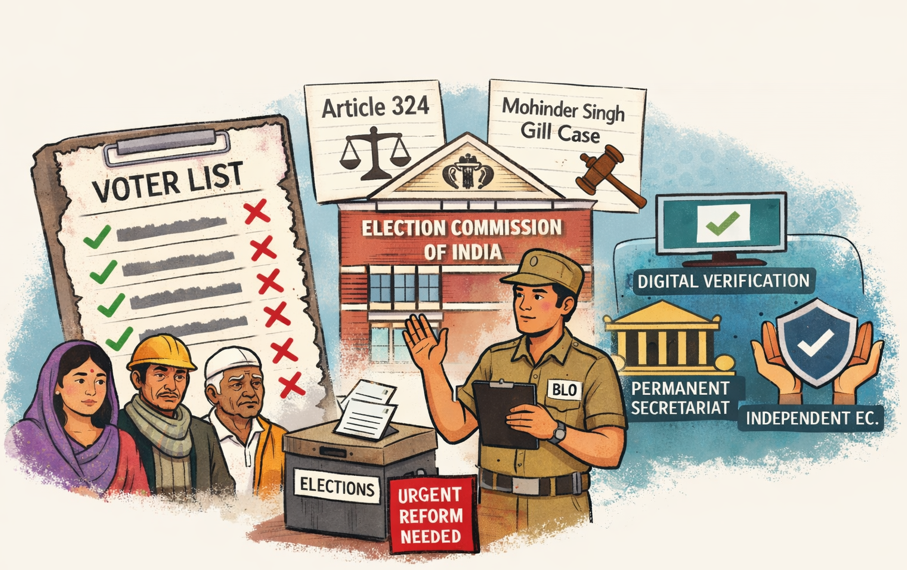
However, the Bihar Special Intensive Revision (‘SIR’) revealed how the operational dependence of ECI undermined its role as a guarantor of free and fair elections. The Bihar SIR process, intended to verify the electoral roll, resulted in mass disenfranchisement. This blog analyses how Bihar’s SIR demonstrated the failure of ECI as a guarantor institution. It further addresses the urgency of rethinking the role of ECI in light of the upcoming electoral developments, such as SIR in other states. In order to ensure the efficiency and proper functioning of ECI as a guarantor institution, the blog proposes reforms such as digital innovations, the introduction of a permanent secretariat of ECI and independent appointments of Election Commissioners.
Bihar’s Special Intensive Revision and Electoral Exclusion
The Bihar SIR process, which was initiated to verify the voter list, became a highly controversial undertaking. In the process, disadvantaged populations like migrant workers, women, landless Adivasis, and Dalits were disproportionately influenced. The names of these people were absent from the voter list, not because they were ineligible, but because they were unable to submit the required documents. The methodology used by the Booth Level Officers (‘BLOs’) was questioned, as they neither provided receipts to electors nor affixed any verification stickers at home. Rather than developing a robust mechanism to verify these voters remotely, the ECI disenfranchised a substantial section of society. The entire process of the SIR revealed how the inefficiency of ECI disenfranchised a significant population of Bihar.
This debate becomes even more imperative since the ECI has initiated a Special Intensive Revision of electoral rolls in 12 States and Union Territories. Moreover, the strength of the Election Commission of India cannot be considered solely based on its day-to-day election operations, but it also needs to be evaluated in terms of its ability to withstand constitutional pressure.
However, the recent lapses in Bihar SIR indicate that an inefficient verification procedure could lead to the denial of voting rights to about 6% or 65 lakh eligible voters. Reiteration of such procedural errors in future processes like the ONOE policy or the delimitation exercise would undermine the universal adult franchise guaranteed under Article 326. Similarly, the Election Commission’s data processing inefficiencies may further widen the existing demographic disparities between northern and southern states. This could result in disproportionate representation and ultimately endanger the federal harmony envisioned in Articles 81 and 170.
Redefining ECI as a Guarantor Institution
The controversy revolving Bihar’s SIR underscores the need to strengthen the Election Commission of India as a fourth-branch guarantor institution. There are certain reforms that ECI must undertake in order to protect the non-self-enforcing constitutional norm of free and fair elections.The ECI must be assessed and reformed by considering the three essential pillars that support guarantor institutions: Expertise and capacity, independence and accountability. Each of these elements is essential to ensure that the Commission carries out its constitutional mandate.
The first pillar on which any guarantor institution thrives is expertise and capacity. The failure to adopt innovative verification methods reflects not merely an administrative lapse, but a deeper deficit in the capacity. The ECI must have adopted innovative methods for verification. In a recent Supreme Court petition, the ECI asserted that it had complete discretion of deciding to carry out an intensive or summary revision. In compliance with Section 21 of the Representation of People Act of 1950 and Rule 25 of the Registration of Electors Rules of 1960, the ECI argued that it has the complete authority to determine the timing and manner of any revisional exercise. In the Bihar SIR controversy, where widespread exclusion took place, such a ground for challenge is crucial. The mass disenfranchisement and arbitrary methods adopted for verification during SIR demonstrated the incompetence of the ECI. This endorses the notion that these broad powers must be exercised with greater responsibility, knowledge and technological ability. For instance, the exclusion of migrants from the verification process could have been avoided by adopting the method of remote verification. The ECI can take inspiration from the approach taken by the Electoral Commission (IEC) of South Africa in revolutionising the process of democratic participation. The IEC developed a mobile app to update, verify and confirm the voters’ registration details, and even apply online for special votes. The digital application adopted by IEC enables remote participation and roll maintenance. It demonstrates how easily accessible technology can enhance electoral inclusion. A similar methodology could be adopted by ECI to promote inclusion rather than exclusion in the process of SIR.
The second requirement, i.e. independence, is equally important in the functioning of ECI. The Election Commission of India, as a guarantor institution, must ensure that it is free from political influence. The decision of the Constitutional bench of the Supreme Court in Anoop Baranwal v. Union of India was a reformative step towards ensuring independence of the ECI. The decision aimed to democratise the process for appointment of Election Commissioners by involving the Prime Minister, Leader of Opposition and Chief Justice of India. However, with the promulgation of the Chief Election Commissioner and Other Election Commissioners (Appointment, Conditions of Service and Term of Office) Act in 2023, the parliament diluted this arrangement. The Act sought to include a Cabinet Minister nominated by the Prime Minister in place of the Chief Justice of India (CJI), as part of the Selection Committee for choosing the ECI. This undermined the independence of the Election Commission by perpetuating executive dominance in the Selection Committee. The Act has been challenged in several writ petitions, which are yet to be decided. The independence of the ECI, ensured by the Supreme Court, has been compromised by the Parliament. This calls for the need to devise a robust mechanism for the efficient functioning of the ECI. A viable solution would be to adopt a multi-partisanship approach in the process of appointments. Inspiration can be drawn from the framework of other countries. For instance, the Constitutional Appointments Authority has a balanced multi-partisanship model where both the ruling and the opposition parties have equal say in the appointment of personnel of guarantor institutions. In the Indian scenario, this would mean revisiting the Supreme Court’s judgment of Anoop Baranwal, where both the ruling and opposition parties have an equal say in the appointment.
Addressing accountability Gaps in the ECI under Article 324
Article 324(1) of the Constitution vests the Election Commission of India with the power of the Superintendence, direction and control of the preparation of the electoral rolls for, and the conduct of elections to the Parliament, State Legislature and elections to the office of President and Vice President. The scope of this article was decided in the case of Mohinder Singh Gill v. Chief Election Commissioner. The court affirmed that the powers of the Commission under Article 324 are plenary in nature, which means they are broad enough to cover all the functions required for the free and fair conduct of elections. It was held that the article is a reservoir of power for the commission to act in areas where the enacted laws are either silent or insufficient to deal with the conduct of elections. The judgment underscored the role of the Election Commission of India in preserving the integrity of elections.
The Bihar SIR reveals a contradiction in the constitutional design. The powers of the Commission are plenary in theory but impaired in practice. The BLOs, who form the very foundation of voter registration and verification, are the state government officials. The Commission does not have its own field-level machinery, which cripples the process of roll maintenance. BLOs who are usually school teachers, anganwadi workers, local bureaucrats, etc. are mainly accountable to the state government. A study revealed that these officers are usually overworked, poorly informed, lack proper training and awareness. The consequence of the same is seen in Bihar’s SIR, which has resulted in mass exclusion.
The Law Commission of India, in its 255th report, recommended the formation of a permanent and independent secretariat for the Election Commission of India. For such a purpose, a new sub-clause 2(A) was recommended to be added to Article 324 of the Constitution of India. The proposal was aimed at ensuring that the Commission had full control over the electoral officials, further strengthening the independence and autonomy of the Commission under Article 324.
Though the recommendation is justified on paper, its implementation poses considerable practical and administrative challenges. Creating a permanent cadre for voter verification and registration would require the recruitment of thousands of officers in a country with approximately 900 million total electors. This would have financial as well as administrative constraints.
The ECI may work towards establishing a permanent secretariat cadre with flexible field staff of BLOs. The permanent cadre working under ECI may comprise trained officials in electoral law, including voter verification and registration. The officers would supervise roll maintenance and ensure accuracy in voter registration. Additionally, they would play a significant role in training and monitoring Booth Level Officers and oversee the work of BLOs closely. Meanwhile, the BLOs could continue to perform their responsibilities under the strict supervision of the secretariat. Such a structure would ensure accountability and the spirit of free and fair elections without straining administrative and finance resources.
Conclusion
The Bihar Special Intensive Revision (SIR) has highlighted an institutional flaw in the Indian democratic framework, which undermines the strength of the Election Commission of India as an enforcer of non-self-enforcing norms, such as free and fair elections. Moreover, mass disenfranchisement in the Bihar SIR process is reflective of a more fundamental structural disorder, which directly questions ECI’s autonomy and legitimacy. Therefore, redefining ECI becomes imperative, requiring normative and structural modifications. Digital innovations, transparent multiparty processes of appointing, and a hybrid permanent secretariat that is composed of a skilled core cadre, as well as supervised BLOs will be a viable way forward for improving accountability and developing institutional competence. The Constitutional vision for Article 324 extends to an independent commission that is autonomous, competent and normatively devoted to the sanctity of Universal Adult Franchise.
Author Bio – Stuti Jadaun and Garvit Garg are second-year law students at Dharmashastra National Law University.
[Ed Note: This piece was edited by Ira Kamat and published by Vedang Chouhan from the Student Editorial Team.]