
The Gujjar leaders’ acceptance with alacrity of the Rajasthan chief minister’s peace formula will be widely admired. Never in the history of such violent protest movements, a protesting group was too eager to grab an olive branch, even though it was predominantly at the receiving end of the state violence. Not just that. A bit of Gandhigiri was also evident; its leader sincerely apologised to the nation for the violence unleashed by the community to express its protest. It is nobody’s contention that the formula unveilded by the Government – the appointment of a commission headed by a retired Judge of the High Court – could lead to a solution which would be entirely satisfactory to the warring groups. It could at best give the Government and the stake-holders a respite from the period of madness which characterised the week-long violence which paralysed life in much of North India, and threatened to unleash a large-scale civil war involving the two dominant communities. Now that peace has returned, the focus must now be on rebuilding the social fabric in Rajasthan and elsewhere, and depoliticise the issue. Today’s story in Business Standard finally focusses on the merits of Gujjars’ demand – a point which I had tried to analyse in my earlier post. Sociologist Nandini Sundar’s article in HT here provides an academic perspective on the issue. The state Government must also act quickly, without further waste of time, in creating sub-categories within the OBC-fold, and apportion a specific percentage for Gujjars within the OBC, without waiting for the Commission’s report. In any case, inclusion in the ST list is a lengthy process, and Gujjars, like others already waiting, cannot aspire for quick decisions in their favour.

GUJJARS’ STIR: THE TRUCE AND THE MESSAGE
Further reading

This article examines India's Digital Personal Data Protection Act 2023, focusing on the adequacy of its consent-based framework as the primary mechanism for privacy protection. It discusses...
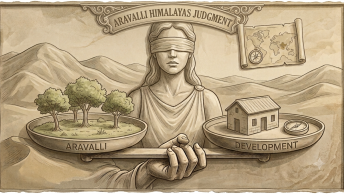
This article examines the Supreme Court’s 2025 judgment on the Aravalli Hills and Ranges, focusing on the Court’s effort to resolve the long-standing definitional ambiguity surrounding the ecosystem...
The article is divided into two parts. Part-I seeks to establish that ASHA workers fulfil conditions to be recognised as workman under the IRC. Part-II aims to show how the feminisation aspect...
The article is divided into two parts. Part-I seeks to establish that ASHA workers fulfil conditions to be recognised as workman under the IRC. Part-II aims to show how the feminisation aspect...

Summary: The article analyses the case of Hari Devageeth v Union of India. It highlights the conflict faced by the court between two constitutional rights: a transgender man’s right to bodily...
Introduction The fifth panel highlighted the multi-faceted dimensions of behavioural accountability within the Indian Judicial system. Moving beyond the constitutional frameworks, the panelists...
We are seeing a lot of instances in this country where violence is being used to meet demands of a community.
I wont be surprised if the Gujjar issue is used by the Supreme Court when it meets after the vacation to discuss the reservation issue. Gopal Subramanium better have something up his sleeve!!