
Introduction
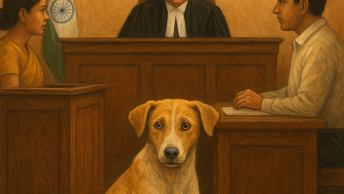
Recently, the Supreme Court took suo moto cognisance of the public-safety risks posed by the increasing populations of street dogs. The problem is simultaneously ordinary and pressing. The Court’s intervention, in the form of sweeping directions to municipal bodies and expanding the ambit across the nation, has revived the long-standing debate in Indian public law between judicial activism and institutional competence.
This essay analyses this intervention by the Court from a constitutional lens. Part I sets out the historical and statutory context. Part II expands on the legal and factual background, analysing how the Court used its constitutional powers (Articles 21, 32, and 142) and public interest litigation (“PIL”) procedures. It further probes whether the chosen remedy respects the separation of powers and fundamental principles of proportionality, legality, and procedural fairness. The conclusion proposes principled limits for future judicial intervention in administrative policy.
I. Historical and statutory context
The jurisprudence of India on animals and public health has developed along two parallel strands. Firstly, the Constitution and statutes (notably the Prevention of Cruelty to Animals Act, 1960 or the “PCA Act”) and subordinate rules (the Animal Birth Control Rules, 2023 or “ABC” Rules) reflect a commitment to humane treatment of animals. The Supreme Court has invoked constitutional morality in a series of judgements, recognising that the unnecessary suffering of animals offends public policy and constitutional values. Secondly, recurrent public-health concerns, especially those related to rabies and dog-bites, have placed immense pressure on local governments to manage stray populations. This primary responsibility for sanitation and animal control has fallen on state municipalities, which often fail to implement or discharge them effectively.
These two strands collide in the classic “Catch-Sterilise-Vaccinate-Release” (“CSVR”) model, as outlined in the ABC Rules [Rule 11]. Stray dogs should be humanely captured, sterilised, vaccinated and returned to their territory. Courts have disallowed indiscriminate culling while urging more effective implementation of sterilisation programs, as held in Animal Welfare Board of India v. People for Elimination of Stray Troubles by the Supreme Court. However, this CSVR model has not been very successful due to various logistical reasons and has failed to deliver on the ground.
The 2025 suo moto proceedings must be read against this legal background, where statutory rules prioritising the CSVR model fail to deliver on the ground and where an activist jurisprudence has historically used PILs to address systemic public-health hazards.
II. The 2025 suo motu proceedings
Alerted by the rising media reports and statistics about dog-bites, the Supreme Court initiated proceedings on July 28th. Initially limited to Delhi-NCR, the Court issued urgent directions to local authorities to pick up stray dogs from specific public places (schools, hospitals, bus stands, highways), vaccinate and sterilise them, and move them to designated shelters. Early interim orders forbade re-release to the same public spaces and empowered authorities to penalise obstruction. Shortly thereafter, in response to interlocutory applications and public outrage, a larger bench modified the orders. The non-rabid dogs could be returned to their original locations after sterilisation and vaccination, while clearly dangerous ones would be detained. A recent order expanded this scope to require uniform action nationwide, requiring compliance reports within hard timelines.
The orders and interventions can be construed as equally important. The Court moved from emergency, hands-on operational directions to a more reasoned order that attempted to harmonise human safety with animal welfare. The interventions were also operationally specific, including directions to build shelters, organise teams, and regulate feeding in such spaces. It was in this precise manner that they raised constitutional questions as well.
A. Article 21: balancing human safety and animal welfare
Article 21 was the principal constitutional anchor for the Court’s intervention. The Court framed the issue of stray dogs as a threat to citizens’ right to life. Children walking to school, patients at hospital entrances, and motorists on highways were presented as having a constitutional right to safety that municipal governments had failed to secure. At the same time, the Court’s reasoning explicitly acknowledged that compassion for animals is a constitutional value, grounded in Articles 48 and 51A(g) as well as statutory protections under the PCA Act and ABC Rules. Thus, Article 21 operated to harmonise a protection for human life that justified the remedial order and as a constraint on the scope of those remedies that could inflict unjustified suffering on animals.
This harmonisation is not new in Indian jurisprudence. When fundamental rights have conflicted with other public values, Courts have had to weigh competing interests and choose the least intrusive means that secures the protected right, a part of the proportionality test. The orders attempted to do that by preferring sterilisation, vaccination and sheltering over mass culling. However, the Court’s initial ban on returning dogs to their locality raised a doctrinal question – what about the ABC Rules, and why was the order undermining the framework already in place?
The subsequent modification of the conditional return post-treatment demonstrated judicial sensitivity to the balancing challenge. However, it also highlighted the difficulty of resolving complex policy questions in a judicial forum while actively undermining legislative rulings.
B. Separation of powers and the limits of judicial competence
The intervention also brought separation-of-powers concerns into the spotlight. Generally, Courts interpret law and enforce rights. Any implementation or detailed design of public-health programs falls within the domain of the executive and the legislature. Prescribing shelters, setting hard deadlines, and enforcement procedures enter the terrain conventionally occupied by administrators and experts. The Court came under much criticism for “policy-making from the Bench,” displacing democratic responsibilities and usurping functions that were not its own, making it a fundamental concern in constitutional governance.
However, many came out in support, arguing that judicial intervention had been compelled by systemic executive inaction that threatened fundamental rights. When legislatures and administrations fail, Courts can, under Articles 32 and 142, order for effective remedies. There are precedents where Courts have issued detailed directions when implementation was recalcitrant.1 Such interventions still need to respect three limits – they should be proportionate to the rights violation, they must conform to, rather than contradict, primary legislation, and the Court should avoid micro-managing administrative measures, preferring instead to set objectives, standards, and monitoring mechanisms while leaving the execution to technical experts.
When seen through this lens, the 2025 orders evoke a mixed reaction. The Court’s objective of protecting the right to life was no doubt legitimate. However, certain directions initially clashed with the ABC Rules and risked contradicting the primary legislation. The Court’s later modified order (permitting return of non-rabid dogs) indicates an institutional recognition of those limits.
C. Procedural fairness and the PIL technique
Suo moto PILs are powerful tools for realising public rights, but raise procedural questions. The speed and urgency of the orders meant stakeholders (veterinarians, animal-welfare NGOs, feeders, resident associations) had limited opportunities to be heard. Principles of natural justice concerns are justified when Courts set policy with far-reaching implications without comprehensive input.
A sound practice in such cases should include early appointment of neutral experts, opportunities for stakeholders to be heard, and careful research before issuing permanent remedies. The Court’s subsequent appointment of amici and the later adjustments show the utility of such practice. The initial reaction and order, on the other hand, raise concerns of ad hoc decision-making under populist pressure.
Alon Harel argues that rights-based judicial review can be participatory because social convictions shape the content and scope of rights. Judges, properly attentive to such convictions, are not aloof philosopher-kings but interpreters of public moral judgements.
The Court’s suo moto action addressed evident public safety concerns, and its subsequent measures in response to those concerns suggest a dialogic responsiveness to societal values. However, Harel’s justificatory logic requires genuine channels of participation, such as the sound practices stated above. Absent those, the claim that the Court acted “participatorily” is weakened and therefore, is only strengthened when Courts’ processes meaningfully incorporate social and expert inputs. Properly structured inputs via plural, transparent expert panels, and open opportunities for public input would prevent judicial micromanagement and ensure that affected communities can meaningfully contest and shape outcomes.
Conclusion
This fiasco brings to the fore both the strengths and the risks of an activist judiciary. Courts can and sometimes must act when governmental failures imperil fundamental rights. As stated, however, these actions should respect certain boundaries to maintain constitutional structures and democratic accountability.
Henceforth, the healthier course of action is legislative reform and strengthened institutional capacities for implementation, so that Courts are not compelled to design and run public-health programs. When Courts intervene, they should do so narrowly, transparently and with constitutionally mandated limits – preserving both the right to life and separation of powers.
1. M.C. Mehta v. Union of India (Kanpur Tanneries – 22-9-87), (1987) 4 SCC 463 (Judicially-driven environmental remediation); Sunil Batra v. Delhi Admn., (1978) 4 SCC 494 (Authorised judicial supervision and remedial directions to prison authorities to protect prisoner dignity and health).